The owner of an equipment-making company with revenues of 200 million watched his key people grow wings and attract poachers. Gritting his teeth, he carved out <strong>20% equity</strong> for five senior executives. The signing day was all smiles.
Eighteen months later: a VP defected to a competitor still holding his shares, demanding buyback "at net asset value"; two veterans started coasting on dividends — same pay whatever the effort; the remaining two pored over the financials asking "why is this year's dividend smaller?" His words still sting: <strong>"I shared real money with them — how did I end up with a crowd of enemies?"</strong>
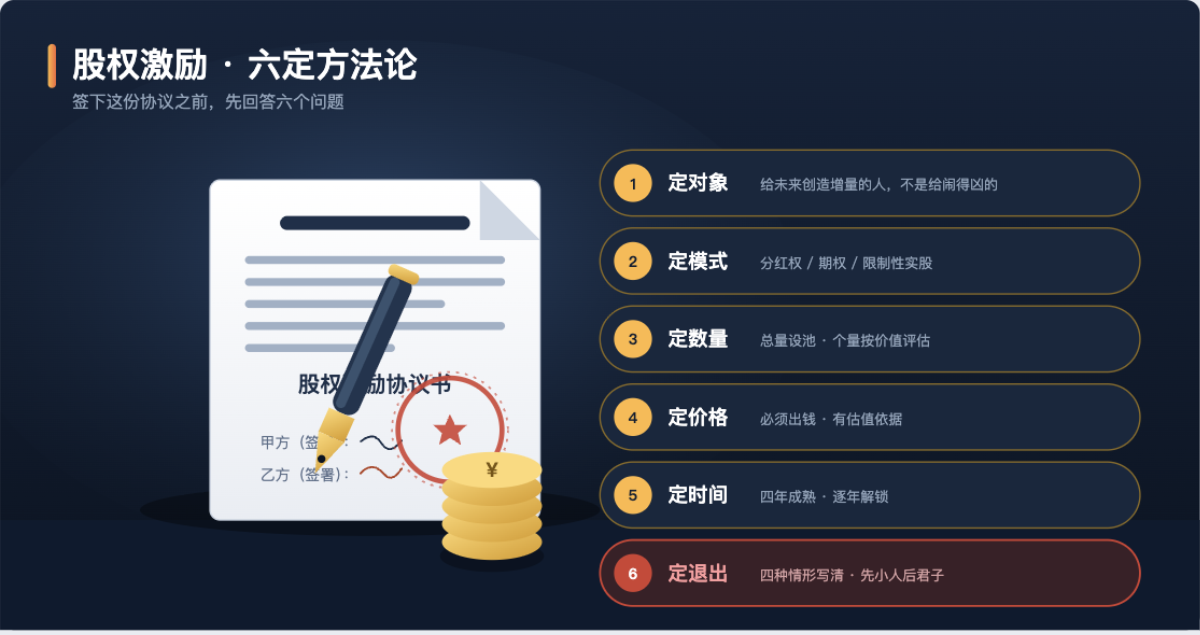
The problem is not sharing, but <strong>how</strong>. Our equity incentive schemes rest on six determinations — <strong>recipients, vehicle, quantity, price, timing and exit.</strong> Skip any one and you are laying a mine for the future.
<strong>Determine recipients: for whom?</strong>
Not for whoever shouts loudest, nor whoever has the longest tenure. One criterion only: <strong>people who will create incremental value for the company.</strong> Past contribution is rewarded with bonuses; equity binds the future.
<strong>The first pit most companies dig: treating equity as welfare — everyone gets some, no one feels anything, and the core's share is diluted.</strong>
<strong>Determine vehicle: with what?</strong>
Real shares, options, restricted equity, dividend rights — the toolbox holds several, each with its use:
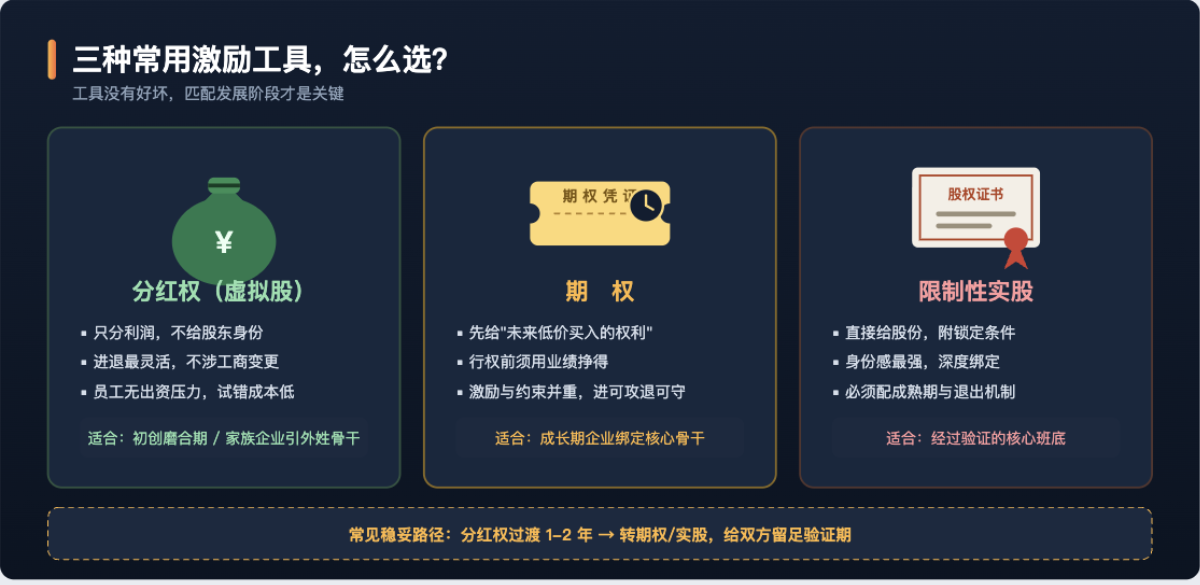
That owner's first mistake: real shares in one step. A two-year dividend-rights transition would have prevented half the problems outright.
<strong>Determine quantity: how much?</strong>
Total pool (typically 10–25% at start-up, 5–15% at maturity) and individual grants. Grant sizing loops back to rule one — value assessment, not negotiating skill. <strong>Quantity without standards is the root of next year's grievances.</strong>
<strong>Determine price: paid how?</strong>
Free is worth least. Even at par, even at a 90% discount — <strong>they must pay.</strong> Paying turns the mindset from "employee" to "partner." Price needs a basis: net assets, earnings multiples or market benchmarks — never a slap of the forehead.
<strong>Determine timing: on what rhythm?</strong>
Equity is trust paid in installments. <strong>Vesting is standard:</strong> four years, 25% a year, the first slice only after twelve months. Leave midway, the unvested part returns automatically.
<strong>Determine exit: how to part well?</strong>
<strong>The most important — and most avoided — determination.</strong> Four scenarios, each with its pricing rules: for-cause departure, no-fault departure, retirement, death. Discuss the breakup while everyone is rational; discuss it after, and it is war.
<strong>Agree on the hard terms first, and everyone stays a gentleman.</strong>
<strong>Six-point self-check: does your equity plan carry mines?</strong>
1. The recipient list was set by the boss, with no value criteria<br>2. The agreement is one page — or verbal<br>3. No vesting; shares in hand at signing<br>4. No exit clause, or just "to be discussed"<br>5. Employees paid nothing<br>6. Dividend rules unwritten, renegotiated by argument every year
<strong>More than three? Complete the scheme before any registration change — a document fixed before signature costs paper; fixed after, it costs lawsuits.</strong>
Equity incentive divides not the stock but the future — <strong>buying tomorrow's performance with today's profit share.</strong> Get the six determinations right before you move.